A plate catalogue of the works.
Arranged three to a row. Select any plate to read the caption, like the work, or leave a short comment.
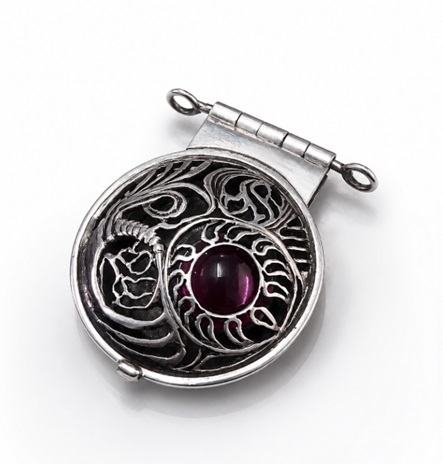
Echo Chamber
- Materials
- Sterling silver, red spinel cabochon, oxidised finish
- Year
- 2025
Leave a comment
A short observation, a question, or a word of encouragement.
- Loading comments…
A circular sterling silver locket constructed with layered openwork and a hinged lid. A red spinel cabochon is set within the interior chamber, yet rises through a precisely formed opening in the upper lid when the locket is closed. The stone therefore occupies two spaces at once: protected within the object and visibly present on its surface. Oxidised recesses intensify the depth of the pierced silver pattern, while the polished edges define the locket’s layered construction and movement.
Echo Chamber explores the tension between concealment and revelation. The locket is traditionally understood as a private container: a small object worn close to the body and associated with memory, intimacy and preservation. In this work, however, what is held within refuses to remain fully hidden. The red spinel is set inside the locket, yet its cabochon surface passes through the opening in the closed lid. It becomes simultaneously interior and exterior, concealed and exposed, protected and vulnerable. The stone acts as the emotional centre of the piece—a pulse that remains visible even when the object is sealed. The surrounding openwork grows across the silver like a network of veins, roots or remembered paths. These pierced structures do not illustrate a specific natural form; instead, they suggest the layered and interconnected nature of memory. The darkened spaces between the polished lines create visual depth, making the locket appear as though its surface has been excavated or gradually opened from within. The hinge is not merely functional. It introduces transformation and sequence: the locket may be viewed closed, with the spinel emerging through its surface, or opened to reveal the stone’s complete setting and the internal structure that supports it. Meaning changes through handling. The wearer does not simply observe the object, but activates it. Within What Survives the Prompt, the piece reflects on what remains irreducibly human after digital speculation. Artificial intelligence may propose an image of a locket, but it cannot independently resolve the physical contradiction of a stone that must be secured inside while passing accurately through a moving lid. That relationship emerged through measurement, adjustment, material resistance and the maker’s judgement. The work proposes that what survives the prompt is not only the finished object, but the intimate knowledge embedded in its construction: the ability to make an interior presence visible without surrendering its protection.
Send your details and the artist will contact you with pricing, banking details, and delivery arrangements.