A plate catalogue of the works.
Arranged three to a row. Select any plate to read the caption, like the work, or leave a short comment.
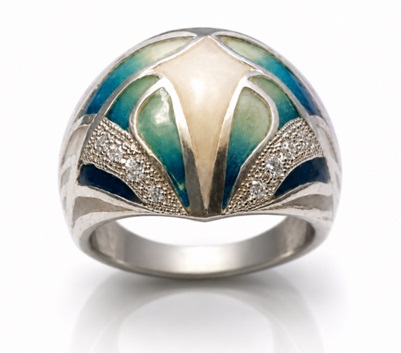
Blue Lotus
- Materials
- Sterling silver, vitreous enamel, white Cubic Zirconia micro-pavé
- Dimensions
- UK size O
- Year
- 2025
Leave a comment
A short observation, a question, or a word of encouragement.
- Loading comments…
A high-domed cocktail ring constructed in silver, with flowing sections of blue and green coloured resin divided by polished silver boundaries. Narrow trails of cubic zirconia move through the surface like illuminated veins or reflections across water. Inspired by the symbolic idea of the blue lotus and the vein structures of the water lily, the piece exists between botanical form, stained-glass luminosity and contemporary surface design.
Although the blue lotus is approached here as an imagined botanical form rather than a literal plant specimen, the title is intentional. It refers to an idealised water flower shaped through colour, memory and design imagination. The “blue” does not claim botanical accuracy, but evokes still water, depth, calmness and the luminous atmosphere associated with aquatic plants. This ring investigates the relationship between drawing, colour and structure through silver, coloured resin and cubic zirconia. It can be understood as a study in resin inlay as drawn colour, where colour is held within a metal framework rather than merely applied to a surface. Each silver division functions like a drawn line, echoing the veins of a water lily leaf as it separates, contains and directs colour across the domed form. The blue and green resin fields suggest water depth, petal surfaces and quiet aquatic movement. Across the dome, the silver framework creates a botanical map: part petal, part leaf and part water current. This tension between organic softness and structural control allows the rigid metal form to suggest fluidity, growth and stillness. The cubic zirconia trails introduce light into the composition. Rather than functioning only as decorative sparkle, they act as luminous veins, like reflections moving across water or light caught within the plant itself. Their brilliance activates the ring as the hand moves and contrasts with the calm saturation of the resin. AI-assisted visualisation was used during the concept stage to test relationships between colour, line, surface and volume. However, the digital image remained speculative. The final work required hand manufacture, technical judgement and material correction to resolve proportion, wearability, stone placement, resin containment and finish. Although the blue lotus is approached as an imagined botanical form rather than a literal plant specimen, the title is intentional. It refers to an idealised water flower shaped through colour, memory and design imagination. The “blue” does not claim botanical accuracy, but evokes still water, depth, calmness and the luminous atmosphere associated with aquatic plants. The ring investigates drawing, colour and structure through silver, coloured resin and cubic zirconia. It is a study in resin inlay as drawn colour, where colour is held within a metal framework rather than merely applied to a surface. Each silver division functions like a drawn line, echoing the veins of a water lily leaf as it separates, contains and directs colour across the domed form. The cubic zirconia trails introduce light into the composition. They act as luminous veins, like reflections moving across water or light caught within the plant itself. The piece becomes a small architecture of water, light and botanical memory.
Send your details and the artist will contact you with pricing, banking details, and delivery arrangements.